Travel Italy Differently: 6 Scenic Train Rides You Can’t Miss
Author:sana
Forget renting a car in Italy. No narrow streets, no ZTL fines, no frantic roundabouts. The train lets you sit back, watch the landscape unspool, and actually enjoy getting from place to place.
Italy’s rail network runs the full spectrum – all-out luxury, budget-friendly coastal hops, and vintage carriages that feel like rolling museums. Here are the best routes across the country, from cross-border Alpine stunners to leisurely trips that move at just the right speed.
Bernina Express – The Alpine Panorama Stunner
Route: Tirano (Italy) ↔ St. Moritz (Switzerland)
Distance: Approximately 122 km (76 miles) from Thusis to Tirano on the UNESCO section
Estimated Cost: 60–70 CHF for second class, 90–110 CHF for first class (€62–€114)
Duration: Approximately 2 hours 20 minutes one way
Official Booking Website: rhb.ch/en/bernina-express
Highlight: UNESCO World Heritage railway crossing the highest railway pass in the Alps
The Bernina Express is arguably one of the most spectacular train journeys on the planet. As it winds from Tirano in Italy up into the Swiss Alps, the train climbs from palm-tree-lined Mediterranean towns right up to snow-capped peaks and glaciers.
On the way, it passes 55 tunnels and crosses 196 bridges, including the famous Landwasser Viaduct and the Brusio Circular Viaduct, which is a 65-meter-high, 360-degree spiral bridge that photographers adore.
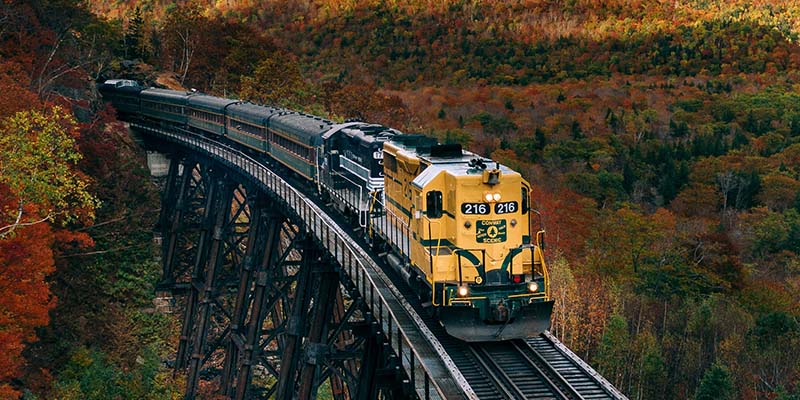
The scenery changes constantly: one moment you’re seeing the icy blue Morteratsch Glacier, the next you’re gliding past alpine lakes like Lago Bianco and Lej Nair, then suddenly the landscape shifts to green valleys sprinkled with stone villages. The journey essentially cuts through three climate zones, so you get snow, forest, and Mediterranean sunshine all in one ride. Trains run 3–4 times daily in summer, with panoramic windows so you don’t miss any of it.
Note:
Seat reservations are mandatory, and you’ll want to book well ahead if you’re traveling during peak summer, because seats fill up fast. If you’re traveling from Tirano to St. Moritz, aim for a right-hand side window seat (everything labeled “Seat A”) for the best glacier shots and viaduct views. The train also has an onboard InfoTainment system, free Wi-Fi, and a full catering service if you want lunch delivered right to your seat.
Pro tip: If you already have a Eurail or Swiss Travel Pass, you still need to pay a small reservation fee (about 10–15 CHF) and you’re good to go.
Cinque Terre Express – The Ultimate Coastal Hop
Route: La Spezia ↔ Levanto (stopping at all five villages of Cinque Terre)
Distance: Short – the whole coastal segment runs just 20 minutes end to end
Estimated Cost: The Cinque Terre Train Card (unlimited train travel between villages + access to hiking trails) costs €17.30 per person for one day during the winter off-season (November 2 to March 12), and between €18.70 and €22.00 per day from March to November, depending on whether you visit in low, medium or high season. Prices for high-season weekends (July–August) can go up to €29.50–€35. Single-journey tickets range from €5 to €10 per ride.
Duration: 20 minutes between La Spezia and Levanto, but you’ll spend a full day hop-on hop-off exploring the five villages
Official Booking Website: trenitalia.com or buy Cinque Terre Card at station ticket offices
Highlight: Pastel-colored villages perched on cliffs, vineyards terraced right above the sea, and the Ligurian Sea sparkling below
If you’re after pure coastal beauty, the Cinque Terre Express is an absolute must-do. This regional train literally hugs the cliffs that support Monterosso, Vernazza, Corniglia, Manarola, and Riomaggiore – the five famous seaside villages of Cinque Terre. The train burrows into tunnels cut into the rock, then bursts out into sunlight to reveal candy-colored houses seemingly glued to impossible slopes, dropping straight into turquoise water.
The ride itself is only about 20 minutes from La Spezia to Levanto, but nobody takes it just to zoom through. The whole point is to hop off at each village, spend an hour or two exploring, then hop back on when you’re ready. Grab the Cinque Terre Card at any local station – it covers unlimited train travel between the villages for either one or two days, and you can also use it for the park trails linking the villages on foot.
Each village has a totally different vibe: Monterosso has a wide sandy beach perfect for swimming. Vernazza’s tiny harbor is arguably the most photographed spot in the entire park. Corniglia sits up on a cliff, so you have to climb a huge staircase from the train station – but the sea views from up there are unforgettable. Manarola has a famous sunset viewpoint. Riomaggiore is the southernmost village, with a pretty little harbor and lots of seafood restaurants.
Best time to go: Shoulder seasons (April–May, September–October) give you pleasant weather and far lighter crowds. July–August can get extremely crowded on both the trains and the trails.
Pro tip:
Sit on whichever side of the train faces the sea – the cars are set up so one side points straight at the Mediterranean. But don’t worry too much about exact positioning: the coastal scenery is so spectacular you’ll be glued to the window regardless.
Milan to Nice (Espresso Riviera) – Glamorous French-Italian Coastal Cruise
Route: Milan Central Station → Pavia → Genoa → Savona → Albenga → Alassio → Sanremo → Ventimiglia → Monaco → Nice (France)
Distance: Approximately 310 km
Estimated Cost: Starting from €54.50 one way, with prices varying by class and season. Shared couchette accommodation starts around €94.90, while private cabins with dinner and breakfast range from €184.90 to €214.90.
Duration: Approximately 6 hours (day service)
Official Booking Website: fstrenituristici.it
Highlight: A restored vintage train that runs along the French and Italian Rivieras, literally just meters from the sea
The Espresso Riviera is a vintage train run by FS Treni Turistici Italiani, using perfectly restored 1980s carriages with a dining car and a bar. Instead of battling traffic on the notoriously backed-up Autostrada dei Fiori, you can sit back near a big window, sip a coffee, and watch the Mediterranean slide past almost close enough to touch.
The whole route strings together some of the most glamorous towns on both the Italian and French rivieras. From Milan you pass Genoa, then hit Alassio (a favorite seaside escape for Italians), Sanremo (flower festival capital and famous for its casino), and Bordighera, then cross into France at Ventimiglia. On the French side, you stop in Monaco (unreal harbor views and a chance to gawk at super-yachts) and end in Nice on the famous Promenade des Anglais.
Inside, the train was designed for comfort: there are private compartments (perfect for couples or families who want some quiet), lots of space to stretch out, and notably a compartment just for bike luggage. So if you want to bring your bicycle along for a coastal ride between Sanremo and Bordighera, you absolutely can. The company deliberately built the Espresso Riviera as a “slow tourism” experience – you’re not rushed, and the trip feels like a vacation in its own right, not just a way to get from A to B.
The train runs during the summer season, typically from August through September, with services on select weekends. Please note that for the 2026 season, the operation status may be subject to change, so it is essential to check the official website for the most up-to-date schedule before planning your trip.
Pro tip:
Bring a light jacket – even in summer, the train’s air conditioning can run cold. Also, book as early as you can, because weekend departures sell out fast.
Venice Simplon-Orient-Express – Paris to the Amalfi Coast (Luxury in a Class of Its Own)
Route: Paris Bercy (France) → (overnight) → Pompeii → Ravello (Amalfi Coast)
Distance: Approximately 1,666 km
Estimated Cost: Starting from £8,600 / €10,000 per person (all-inclusive)
Duration: Approximately 72 hours (includes train travel + two nights at a Belmond hotel)
Official Booking Website: belmond.com/trains/europe/venice-simplon-orient-express/
Highlight: First-ever direct rail route from Paris to the Amalfi Coast, with a private Pompeii tour and a stay in a clifftop palace
If money is no object and you want what is arguably the most glamorous train ride on Earth, the Venice Simplon-Orient-Express’s brand-new Paris–Amalfi Coast route, launched in May 2026, is your answer. This three-night trip is a partnership between the legendary midnight-blue carriages of the Simplon-Orient-Express and two nights at Caruso, A Belmond Hotel, a former 11th-century palace perched 1,000 feet above the Tyrrhenian Sea in Ravello.
The journey starts with a Champagne welcome in Paris. You settle into a historic cabin, an elegant suite, or an over-the-top Grand Suite. As evening comes, the train serves a multi-course dinner inspired by the French and Italian regions you’re passing through, then you drift off to the sound of piano music in the legendary Bar Car “3674”. The next morning, you wake up to the Italian countryside rolling past your window. After lunch on board, the train arrives in Pompeii, where guests get a guided VIP tour of the ancient ruins – Grand Suite guests get exclusive access to the rarely opened Casa del Larario Regio V.
From there, the train winds south to Ravello, where you move into the Caruso hotel. The property has an infinity pool that seems to float above the cliffs and gardens overlooking the entire Amalfi Coast. You’ll find optional excursions here – painting classes, cooking lessons with the hotel’s executive chef, speedboat tours around Positano – all included in your package.
For 2026, Belmond also introduced similar three-night Italian journeys that end in Venice (with a stay at Hotel Cipriani) and Florence (with a stay at Villa San Michele). So even if the Amalfi Coast route is sold out, there are other similarly opulent options.
Dress code: Formal attire for dinner every night, and jeans are prohibited throughout the trip, so pack appropriately.
Booking: You need to register interest on Belmond’s website to get notified about departure dates. The trip runs on a very limited seasonal schedule, and tickets are already in incredibly high demand.
Ferrovia Circumetnea – Circling Mount Etna on Sicily’s Quietest Train
Route: Catania → Randazzo → Riposto → back to Catania (full loop around Mount Etna)
Distance: 110 km
Estimated Cost: €6.80 for a one-way ticket, €13 for a day ticket
Duration: Approximately 3–4 hours for the train ride, but plan a full day if you get off at villages along the way
Official Booking Website: ferroviacircumetnea.it
Highlight: A slow, old-school railway that circles the base of Europe’s most active volcano
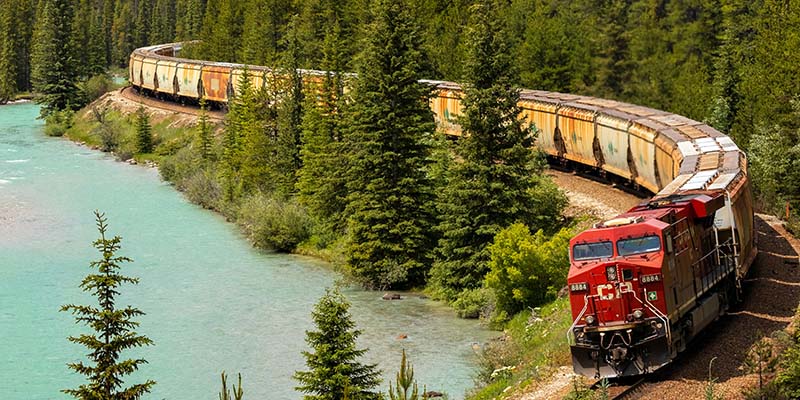
The Ferrovia Circumetnea first started running in 1898, and to be honest, not much about it has changed since – but that’s part of the charm. This narrow-gauge train chugs around the entire circumference of Mount Etna, offering a ground-level perspective of the volcano that most visitors never get. While other tourists pay for cable cars or guided jeep tours, on the Circumetnea you get to see the entire “Ring of Fire” across dozens of small stations and volcanic landscapes.
You start in Catania, on Sicily’s east coast. The first part of the journey snakes along Etna’s outer slopes, and the views of the crater are constant. The line passes through farmland, then climbs up into black lava fields and pine forests. Along the way, you’ll roll through small towns like Bronte, famous for its green pistachios (which hold a PDO certification), and Randazzo, a medieval hill town with dark lava-stone buildings that looks like it was built right out of the mountain’s own minerals. The total train travel time from Catania around the volcano to Giarre-Riposto is about three hours.
The best way to do the full loop is to catch one of the regional trains in Catania (departures at roughly 8:05 AM and 12:20 PM), ride to Randazzo, change trains there, and then take the main line back to Catania. That gives you enough time to wander Randazzo for lunch. The Ferrovia Circumetnea also has a metro line within Catania, which can be confusing if you speak zero Italian – so ask for “Circumetnea” specifically, not “Trenitalia,” since the Circumetnea operates as a private railway.
Pro tip: Check the schedule at the station the day before you travel – Sicilian trains on this line can run, shall we say, on local time, and the online timetables aren’t always perfectly reliable. Also, to avoid the afternoon heat, aim for the morning departure.
Trenino Verde (Little Green Train) – Sardinia’s Slowest, Most Magical Ride
Route: Arbatax → Lanusei → Gairo (Ogliastra mountains). Please note that the train between Lanusei and Gairo is actually a connecting shuttle bus, rather than a direct rail route, but it’s all part of the same scenic package deal.
Distance: 22 km (Arbatax to Lanusei segment)
Estimated Cost: Adult tickets start from around €49 for the full experience (including the bus transfer to Gairo), with optional food and beverage tastings or excursions adding extra cost.
Duration: 90 minutes for the short Arbatax–Lanusei run; longer routes (like Mandas–Laconi or Luras–Tempio) can take 3–5 hours
Official Booking Website: treninoverde.com
Highlight: Ride through Sardinia’s wild, barely-touched interior across narrow bridges, deep gorges, and ancient forests
The Trenino Verde (literally “Little Green Train”) on the island of Sardinia is the very definition of “slow travel.” These narrow-gauge trains were originally built to connect remote mountain towns, and today they’re used almost exclusively for tourism. The trains date back more than a century and run on about 404 km of track that’s used only for scenic tourism now – meaning no clattering freight trains or loud commuter crowds.
The route from Arbatax to Lanusei is one of the best short introductions to Sardinia’s interior. Arbatax sits on Sardinia’s east coast and is known for its red rocky coastline. As the train climbs inland, the Mediterranean scrub gives way to rugged mountains, oak forests, deep valleys, and towering Romanesque bridges spanning gorges that look like they belong in a fantasy film. The train sometimes runs along narrow mountain ledges with drops directly below – thrilling in a low-speed, well-braked kind of way.
Longer routes, such as Mandas to Laconi (crossing the Sarcidano valley, described by D.H. Lawrence in his travelogue Sea and Sardinia), and Luras to Tempio Pausania (through Gallura’s granite hills and cork-oak forests), are just as magical, but they require a bit more planning. You can also charter the entire train for a private group during the off-season (October–May).
The Trenino Verde runs only on seasonal schedules – typically from April to September, with varied operating days depending on the route.
Pro tip: Even though many online sources still list the Friday-only run for the Arbatax–Lanusei route, always check the current year’s schedule before you go. Most stations don’t have digital signage, so confirm times with the train manager before you get off to explore. Book direct on the Trenino Verde website for either a straightforward train ticket or a full-day guided tour that includes entry fees and local lunch stops.
Top Tips for Train Travel in Italy
Download the Trainline app for e-tickets and real-time schedules. If you buy paper tickets (for regional trains, regional Intercity trains, or the Circumetnea), don’t forget to validate them in the little green or yellow box at the station entrance before you board. Unvalidated paper tickets are treated as if you never paid and subject to heavy fines.
Italians run on, er, flexible timing – trains can sometimes be 5 minutes late, 20 minutes late, or completely no-show on Sundays and holidays in more remote rural regions. Always have a backup plan for the end of your route, especially if you’re traveling on the Trenino Verde or Ferrovia Circumetnea. Don’t schedule a tight connection to a flight or a bus that runs only once a day.
Luxury trains like the Venice Simplon-Orient-Express and Bernina Express require seat reservations months in advance. The earlier you book, the better, especially for summer weekends.
Regional trains in places like Sicily and Sardinia are the best way to see the countryside, but they move slowly, stop frequently, and sometimes run on single-track lines where delays compound. Just build some flexibility into each day and you’ll be absolutely fine. There’s no better way to stumble on a random hilltop village you’d never see from a highway.
Latest News
Atrani, Italy Travel Guide: Where to Stay, What to See, and When to Visit
March 8, 2026
How to Travel Overnight in Japan for Under $300 (Trains, Buses & More)
February 16, 2026
From Tulips To Snow: Discover Turkey's Top Region For Every Season
October 20, 2025
Why Ziplining in the Mountains Feels Like Flying
September 30, 2025
How To Get Cheap Broadway Tickets Online: Tips And Discounts
September 18, 2025
Budget Travel: 15 Ways to Save Money Without Living on Instant Noodles
September 8, 2025